Backyard Landscaping Ideas

No matter where you live, there’s nothing better than relaxing outdoors on a warm summer night watching your backyard landscaping ideas come to life.
Unfortunately, re-landscaping your entire backyard during the course of one growing season can be back breaking, expensive and requires major planning.
Here’s a simple solution: Break up your backyard into “rooms” and remodel one room each year. This is especially helpful if you’re on a budget. You’re results will be much better if you spend as much time and money as you can on one project, rather than trying to revamp the entire backyard all at once for the same amount of money.
Although you’re landscaping only one section of the yard at a time, you still need an overall plan. Using graph paper, sketch out the permanent structures on your property including the house, out buildings, deck and trees.
This is also a good time to consider which existing plants and shrubs won’t be a part of the new landscape.
Make copies of your sketch and experiment with different designs. Incorporate ideas you like from magazines or gardens you’ve visited.
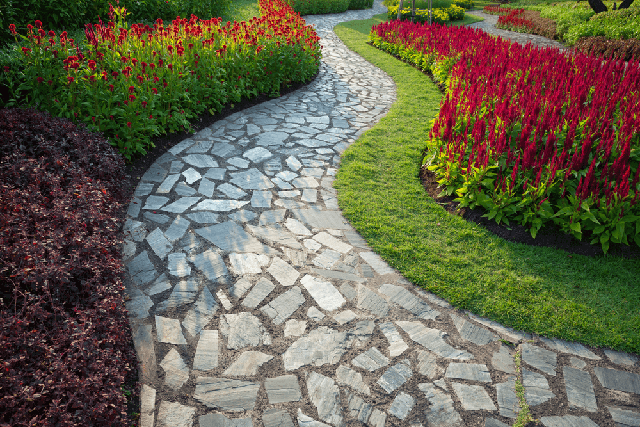
If you host frequent cook outs you’ll probably want to keep the yard open and plant along the borders. If you don’t need the space, you could create real drama with an island bed, walkways, solar lighting and cutouts for comfortable furniture to relax on.
Here are some ideas you’ll dig:
Screening with Plants
If your yard doesn’t have a fence, you might want to consider planting a row of hawthorn, juniper, arborvitae, or a combination of these bushes to create privacy and provide a backdrop for future flower beds. A strategically place evergreen screen will also provide a windbreak from winter winds and drifting snow.
Planning a Border Flower Bed
The hardest part of designing a border is choosing flowers that complement each other both in color and height. The list of perennials I suggest here is for a six foot wide bed in a mainly sunny situation. Wide, in this case, means outward from the plant screen or fence, not the length of the bed.
Use 3 or 5 plants for each kind of flower and allow 16”–18” between each plant. Allow 20”–22” between the different plant groups. Planting an odd number of plants is more visually appealing than an even number.
Allow sufficient space at the rear of the bed for access. This will also prevent choking off necessary air and light from the plants in back.
These are my suggestions for a perennial border. They were chosen to give a long display, with the first flowers appearing in April and the last in October.
Tall plants for the back row: SEDUM ‘Autumn Joy’; RUDBECKIA Goldsturm; PHLOX White; IRIS light blue or yellow; VERONICA Blue; SOLIDAGO ‘Golden Shower’; and HOSTA fortunei ‘Picta’.
Shorter plants for the front row: GERANIUM grandiflorum; POTENTILLA ‘Firedance’; HUECHERA Pink; ASTER Dwarf Blue; SEDUM Dragons Blood; ACHILLEA ‘Moonshine’; and ERIGERON ‘Prosperity’.
Obviously, these plants won’t be the best choice for every climate. A worthwhile book to help you choose plants native to your climate zone is The Comfortable Lazy Garden. It’s also an excellent reference for beginning gardeners.
Island Bed
An island bed, as the name implies, is planted in the middle of the yard surrounded by a sea of grass. It can vary in shape and size according to your imagination and available space. Scale the plants from tallest in the center to shortest at the edges.
Preplanned Gardens
I understand all of this Latin mumbo jumbo can be daunting for first time gardeners, it was for me. If you would like a ready made solution, Direct Gardening offers a wide selection of preplanned gardens designed to take all the guess work out of plant selection and placement.
Water Feature
Imagine the reflective beauty of a pond or the gentle splashing of a man made waterfall. How about a 100 foot high waterslide? Maybe next year.
Do Your Yard a Favor
Before you buy any vegetation, visit a real garden center for advice on drainage and soil preparation. Also, bring a copy of your plan; a soil sample and an extra credit card just in case you can’t wait years to make your backyard landscaping ideas come true.