Common Landscaping Tools For Every Landscaper

Common Landscaping Tools For Every Landscaper
For the avid do-it-yourself landscaper, the right tools are important. After all, if one wishes to save money on the expenses associated with having a well cared for yard, it is best to make sure that he or she has all of the tools necessary to create an attractive landscape. By understanding some of the most common tools used for basic landscaping needs, you can ensure that you have everything you need to keep your lawn in the best possible shape, bringing delight and distinction to your grounds, be they large or small.

Shovels, rakes, trowels, and hand cultivators. These are the most basic of tools when it comes to landscaping. Every home should be supplied with these basic implements. They make just about every landscaping endeavor possible. Shovels to remove sod and turn soil, as well as dig the holes necessary for fixtures like trees and hardscapes, Rakes are essential to smooth out planting beds and prepare ground for things like sod without packing the dirt. Trowels and hand cultivators allow you to perform minute work that requires more attention to detail. All of these tools are necessary to the proper functioning and care of a landscape.

Pruners and shears. These tools are used to improve the appearance of woody plants and trees. They keep plants from encroaching in other areas, and they also promote the overall health of the plants. They help maintain a neat appearance, and if you have topiary concerns, they are indispensable in maintaining a set shape. There are hand pruners, tools that help with the smaller branches and are easier to use, loppers for getting thicker branches that are to large for pruners, and even pruning saws that can help you with the toughest of branches. Hedge shears provide a way for hedges to be trimmed more conscientiously than with electric or gas-run trimmers (although these are widely available and can make maintaining hedges much easier).

Lawnmower. This is perhaps one of the most common and most obvious of landscaping tools. It is meant to keep the grass at a reasonable level, and to keep the lawn neat and healthy. Related to lawnmowers in the trimming department are things like weed wackers, which are very useful in keeping edges that can’t be cut by a mower nice and neat. Additionally, the use of some special machinery, designed to eliminate thick brush is useful to have on hand, even it is only in the form of a machine rented once a year.

Other tools of interest. Of course, there are specialty tools that may be needed depending upon on the features of your landscape. If you have a water fixture, it is important to make sure that you have the proper pumps and filters, and that you have little skimmers that can allow you to remove larger pieces of debris from the water. Automatic sprinklers can make watering the lawn and your other plants much easier, and you should have a garden hose for special watering needs. Regular household tools such as hammer and nails, levels, and drills can be helpful if you have built landscape features like patios, decks, pergolas, and trellises. They can also be useful in building things like containers and creating raised beds.

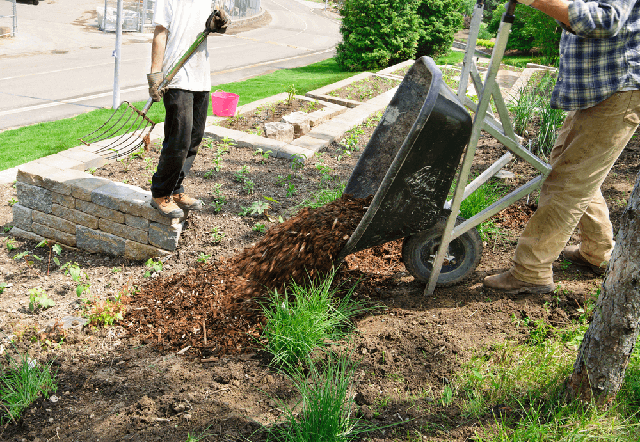
Wheelbarrow. A wheelbarrow will always be of infinite use for the avid landscaper and improver. Wheelbarrows are very useful for moving debris as well as bringing needed implements to their proper places. They haul dirt and bring in plants. They make it possible to for one person to carry a load that otherwise she or he would not be able to handle. For the serious landscaper, a wheelbarrow is indeed necessary.

When you have all of the tools necessary to take care of your landscape, then you are well rewarded for your hard work. Acquiring the more common tools can also save you money in the long run, as they can be used over and over again. Additionally, many of the more common landscape tools are fairly small in size and easy to store in a garage or a shed. As long as they are kept neatly arranged in place, they are easy to get to when needed, and not hard to find. Proper maintenance of you tools is important: keep them from becoming rusty, and make sure your lawnmower and other gas or electric implements are well oiled and always have plenty of gas. Proper care of your tools ensures that you will be able to properly care for your landscape.

Landscaping On A Budget

Landscaping On A Budget 1

It is possible to have an appealing, unique look to your yard without investing thousands of dollars every year in order to do so. Practicing some basic conservation rules can help you to save money and still make your yard look great.

One great new innovation that is all the rage is the art of xeriscaping. As water becomes ever more valuable a commodity, many homeowners are seeking to conserve their water costs by choosing plants that do not need very much water in order to survive. These plants are available in many different varieties, and they will add a splash of color to your yard while still saving you money. Know which plants tend to use a lot of water- cedar hedges, for example, are the landscaping equivalent of the sports utility vehicle. Don’t plant any if you are concerned about your water costs!

Another way to save money on water is to include a material in your planting that has good water retention qualities. Peat moss, for example, is very cheap. When you mix it in with the dirt and bone meal while planting your new flowers or hedges, any water that goes near the area will be soaked up and retained for later use as the plant’s needs dictate.

As with many other areas of budget concern, the best way to stay within your means when it comes to landscaping is to do the job yourself. This means everything, from picking your plants to weeding and pruning. With the information age in full swing, though, it is not hard to educate yourself well on all the different tasks specific to your yard.

When it comes to weeds, you are probably going to have to expect a few. If you wage a campaign against your weeds, and this is especially true of your lawn, you are going to end up spending a lot of money and time on various chemicals and treatments, processes which, in the end, may end up doing more harm than good. Be content with some weeds on your lawn, particularly if they have some aesthetic appeal, such as clover.

Don’t be afraid to skip the nursery and buy your plants at a box store. A lot of the time, the plants you buy at a big store that carries many varieties of items will cost much less than those at the local nursery. These plants will not have been tended as carefully as the nursery plants, but with some care taken in the planting and tending, they will probably grow to the same levels in terms of appeal as will the plants which cost more but took less time initially in tending. Most do-it-yourself gardeners like to maximize their time outside anyway, so the extra attention these plants may need will help to increase the time spent on your hobby.

One of the best ways to keep a low budget in your landscaping is to limit your green space. Smaller lawns, and less flowers mean less materials needed for the upkeep. Watch what you use as your replacement, though- some types of landscaping rocks (such as lava rock) can be incredibly overpriced. Bark mulch is a fairly inexpensive option, but again, you have to be willing to invest a little extra time into its containment and maintenance.

Cheap Landscaping Ideas

Cheap Landscaping Ideas

This blog is on cheap landscaping ideas. One of the main hassles of a garden is not planting, but weeding. Weeds grow with remarkable speed and can quickly overtake a garden. Using a poison or herbicide like roundup is not recommended as you might kill your plants. I know that the manufactors claim the product breaks down in the soil very quickly but I find with my lawn edges after a second dose of roundup no grass is growing there six months later.
In moving into a new rental property I had a large front garden with a nice quickkerb concrete border to highlight the beautiful weeds. So I began to weed, got sick of it and left it for a month. Big mistake, there were now more weeds than ever. I was going to have to have mulch it or spend everyday in the garden. With the landlord not interested in paying for it it was going to have to come out of my own pocket. Now I don’t mine paying for gardening supplies, plants, etc when its my own place, but I’m certainly not keen on giving my landlord a free ride.
So I needed a cheap mulching option, that would look good, work, but not cost too much.
I chose three basic supplies, newspaper -the local rags free and it doesn’t take long to build up a stock pile of papers, sugar cane mulch – its comes in a big bags and is cheap, and finally a few bags of bark – not so cheap, but as you will see its used to give colour not as a mulch so only a little bit is required.
Step One:-
Prepare the garden, yes this means a huge effort and weed the whole garden by hand. Rake over the soil so its nice and smooth and then apply the newspaper. The thicker the better.
Min. six sheets thick. Spread it out and then with a hose wet it all down so it soaked. The now heavy paper won’t blow around in the wind and will mold better to the grounds surface.

Step Two:-
Next spread out the sugar cane mulch. If you cant access cheap sugar cane mulch, try straw, but ensure it has no seeds in it. Make sure all the paper is covered. It doesn’t have to be deep, just enough to cover all the paper. Once again apply water to damp down the mulch. Once watered it takes on a lovely golden colour.

Step Three:-
Now apply the bark. Just grab handfulls and throw it around. You don’t want to totally cover the yellow mulch, the barks mainly to give colour and to contrase with the mulch.

I have found this to be a very effective mulch. A year later and few weeds can get through. Nutgrass was the only successful one and I pulled those out by hand and even the nutgrass gave up the fight. The beautiful browns and golden colour unfortunately fade under the harsh sun, but by that time you should have plenty of flower to make up for it. Best of all – NO WEEDING, yes.

Helpful Landscaping Ideas

Landscaping Ideas 2

In architectural terms, landscaping means the art of modifying land areas through the use of natural, cultivated, or constructed elements in an organized manner and with accordance to a comprehensive yet aesthetic planning. If you are getting interested with this art, it is best to come up with fresh landscaping ideas to set your self apart from the rest.

Indeed, landscape design is one of those terms that can be quite overwhelming especially for neophytes. But, this doesn’t have to sound so intimidating because the underlying principles in it can be translated in simple terms or layman’s terms, so to speak. Once translated into less complicated terms, landscaping would be easily understood and more people can do it on their own.

Aiding the ideas of creation

If you new into landscaping, you need to landscaping ideas to help you create you own one. But, before going gaga over numerous landscaping ideas out there, you need to familiarize yourself first with the basics of the art. These include knowing the basic elements of landscape design such use of colors and its combination as well as the various color theories. The standards of forms, lines, scales, and textures should also be pondered upon.

To help you come up with your own landscaping project, here are some helpful landscaping ideas that you can use in order to enhance the beauty of your home or make your own personal space pleasing to the eye.

1. Always assimilate the hardscape into the initial and final landscape design. “Hardscape” refers to elements and features including fences and other decorations used in the garden as well as patios and decks because these will give a wonderful transition coming from your indoors to the outdoors of your garden. Always make sure that the elements used in hardscape will complement other elements such as plants.

2. Try building a dependable but fashionable set of fences. People might not notice it but fences—if placed and designed properly—can create a huge difference in the overall look of the house. When doing your own landscape, make sure that you invest on great-looking fence because it will be standard in the garden. To be more creative, try to use plants as a fence aside from using the traditional wood ones. Here, you have a unique and reliable fence that will speak of your distinct taste and preference. But, if you plan to use plants as fence, make sure that they are composed of shrubs so they will be easier to manage.

3. Consider using foliages and drought-tolerant plants to use. If you are not sure if you can take care of the plants in your garden regularly, make sure that you use plants that don’t need constant watering and taming.

4. Combine colors of plant foliages and flowers. To create an eye-catching landscaping, always think of the characteristics of the foliage. Make sure that the foliage of plants has various textures and colors to create easy patterns that are pleasing to eye.

5. Be experimental in choosing materials. One of the most refreshing landscaping ideas out there is the use of substitutes in place of the traditional ones. This is because in enables the designer to explore more possibilities and lets him or her to be more creative.

One good example is the use of wood chippers especially for those who constantly redesign their space. These are a good option especially for people who want to trim their growing plants often.

Steps to Go Through Before Residential Landscaping

Steps to Go Through Before Residential Landscaping

Whatever the project may be, if it is a big time one or a simple residential landscaping, design is the most important factor that one must consider to be able to lay out a plan and eventually act upon.

Residential Landscaping
In whatever we decide to do in life, there are things to ponder about before coming up with a plan. The same thing is true if you’d like a lawn makeover, there are factors to go through and ideas to think about before actually starting the process.

Why Do You Want to Do It?
If the idea is to give your yard some kind of a renovation through landscaping, then the possibilities as to what you’d like the outcome to be are endless. You call the shots according to what you like at the moment that you want it to be done.

But on the other hand, you have to give the landscaping design a more posh look if you decide to sell the property. This is also a way to be safe, not every potential buyer would want an unfamiliar style, but with being simple and classy, one could never go wrong. It would also be to your advantage because it will add more value to what you’re selling and more people will be enticed to look at it and consider a deal.

What Do You Want to Be Done?
For people who’d like to do their own landscaping, the American Nursery and Landscape Association or ANLA says that it is important for the property’s salability if you choose to maintain large, old trees in it. Those mature trees are said to be of great impact to those who are looking into the land.

In designing for your own landscape, remember the basic elements which are color, form, line, scale and texture.

Look at the project through an artist’s eye. Choose plants that look good when placed together or side by side in terms of their colors. Imagine what other people, especially the would-be buyer of the property would feel upon seeing the colors that you chose for the project.

Form is looking at the plants to be placed in the project in terms of the shape and branching patterns. Such factors should blend in with what one has planned for the whole landscape.

Line is the according to the arrangement of the materials to be used in the design, how you plot them accordingly as well as looking into their borders.

Scale or the size of the plants that you want to use in the landscape design also determines the texture. The placing of each plant depending on its sizes would give one an idea about the texture because this factor is a visual matter.

Who Do You Like to Do It?
You could seek out professional help if you think that you cannot do it yourself. But with vast resources on landscape design, you might want to try browsing through first and challenge yourself if you can do it before shelling out your penny for someone else’s services.

First, you need to observe other people’s backyards. You might also want to ask how they have done it. Or if you see someone else doing such, all you have to do is watch the process and get inspiration from it.

You can also find a wealth of information from landscaping books and magazines, television and, of course, the Web.

Are You Up with the Plan?
Upon having the plan ready for your residential landscaping, you just have to ask yourself if you’re up for it. Consider everything, the budget, the materials, your purpose on doing such and the property itself, before plunging in and starting out the process.